The Year of the Wood Dragon calls out for something cosmic from the TAROT OF DRAGONS. Here is my 5 Dragons Draw for the coming year.
SIGNIFICATOR: Sire of Pentacles.
When I think of Wood Dragons, I think Pentacles, especially the Sire of Pentacles.Once upon a time, a rangy young dragon barely old enough to fly planted a sapling on a hill. The centuries passed, and together they grew. Now he is the Sire of Pentacles. The power of his blood and years, of the very earth on which he stands, radiates from every scale and whisker. Dragon and tree are one, his wisdom and honor spread wide as branches, sheltering hidden owl, wren, and squirrel.
The Sire of Pentacles is powerful and disciplined. He has an alchemical gift when it comes to material wealth. He understands the real world as well as anyone and knows how to invest time and energy. Like a proper Sire, he protects and provides for all in his care. He knows that want breeds despair, and despair kills as sure as hunger. Far from ascetic, he is liberal with his resources, giving freely for the greater good of family, friends, and strangers in need. Under his reliable and steady influence, everything you touch prospers and grows. Be quick to laugh; see others clearly and love them just as they are.
EARTHLY DRAGON: Six of Cups.
This is our foundation, the card of roots digging deep and nourishing the year. The Six of Cups tells us the year is rooted in nostalgia and memories. We look to times when happiness came as naturally as breath. Times when the simplicity of the moment and friendship shared warmed us like the mid-day sun and innocence washed the spirit clean as new-fallen snow. Oh, to feel the blush of youth and know such uncomplicated joy again! At least that is our memory…As the year unfolds, be careful not to get lost in the past. There are pleasures in the now, too. Old acquaintances are rekindled, new friendships made. Be guileless and kind. Let your inner dragonlet come out to play.
COILED DRAGON: Four of Wands.
This is the card of energy and growth, of change about to happen. The Four of Wands is full of festive energy. Your labors have come to bountiful fruition. It is a time of thanksgiving. Time for flower petals to fill the air like butterflies. To laugh and frolic and with each step, pound the dancing ground and make the earth move. In short, take a well-earned rest and celebrate. Give thanks; be satisfied with work done well. Yet remember: success is not a solo venture, rather something to be shared with the community. Youth looks on youth with an eye to friendship or possible romance. But your eyes are clear. Deep as your desires run, they are grounded in reality. This way happy unions lie.
HIDDEN DRAGON: Ten of Cups.
This is the card of the heart, of emotional influences and the power of intuition, of answers once buried which are now about to surface. The Ten of Cups fits the Hidden Dragon like a gauntlet. Emotions once kept in check are ready to come out and play. Everyday existence is bright, inspired, and as rich with wonder as the Northern Lights. Family affairs are harmonious and joyful; relationships endure in celebration. Under the arc of the Ten, inner peace and awareness grows. You know that in union, sorrows are lifted, strifes lessened. That happily-ever-after, though real, is ephemeral. And that family is more than blood. These are the lessons of emotional maturity. Treasure their wisdom; pass them on.
HEAVENLY DRAGON: Ace of Pentacles.
This is the card of the head, of thought and breath, and the words that come with using both wisely. It is also inspirational, granting a glimpse at your hopes for the future. With a puff of her puissant breath, the Ace of Pentacles tells us the material world beckons: health, wealth, and beauty hatch forth, at times unexpectedly. Seeds are planted, great plans are laid. Focus your mind on the practical, on the ebb and flow of the natural world. With diligence and labor, dreams turn into reality. With the lofty perspective of the Heavenly Dragon, you see the bigger picture and remember that prosperity is a means to life, not an end.
SPIRIT DRAGON: XVI—The Tower
The Spirit Dragon represents a synthesis of the cards that came before, the outcome of this New Year’s query. The Tower indicates draconic change in in the air. Life has become static, full of habits and rules which, though once useful, even comforting in their familiarity, now feel toxic. Violent and unexpected, the cataclysmic fury of the dragon is just the life-altering change required. Break free—raze the old Tower to the ground. Sometimes it is the only way forward, out of oppression and into freedom. Scary as such upheaval feels, try not to panic. After the fall, rise and start anew. The Wood Dragon is gentler than some of her kin and will extend a paw and help you through.
Once every sixty years, the Wood Dragon dances across the heavens bestowing her many blessings upon us mere mortals. 2024 is such a year.
So…What does this mean? Like all Zodiacal Dragons, the Wood Dragon is full of energy and passion and augurs success. Yet there is an added gentility to the Wood Dragon. An extra dose of compassion and empathy.
Those born under the auspices of the Wood Dragon are confident, almost fearless, with a charisma they wear as casually as a second coat of scales. They are eager to lend a paw in times of need, and their empathetic natures put them at ease with everyone. Wealth and status—or lack thereof—are but superficial distinctions to the Wood Dragon.
Wood Dragons have unique ways of looking at problems. Indeed, the phrase “thinking outside the box” can be laid squarely at their paws. This makes them very adept at navigating tricky situations, their compassionate natures leading them to find peaceful solutions whenever possible. Trying new things delights them, and conversely, routine makes them restless and surly. Good-natured though they usually are, you really don’t want to mess with a surly Dragon, Wood or otherwise.
So, for all Wood Dragons—and those of us who are tickled by her whiskers—an exciting year lies ahead. Lean into your draconic strengths, temper your draconic excesses. Extend your wings, soar high and enjoy.
From a position of strength, connect and be joyful. From a place of prosperity, be generous and caring.
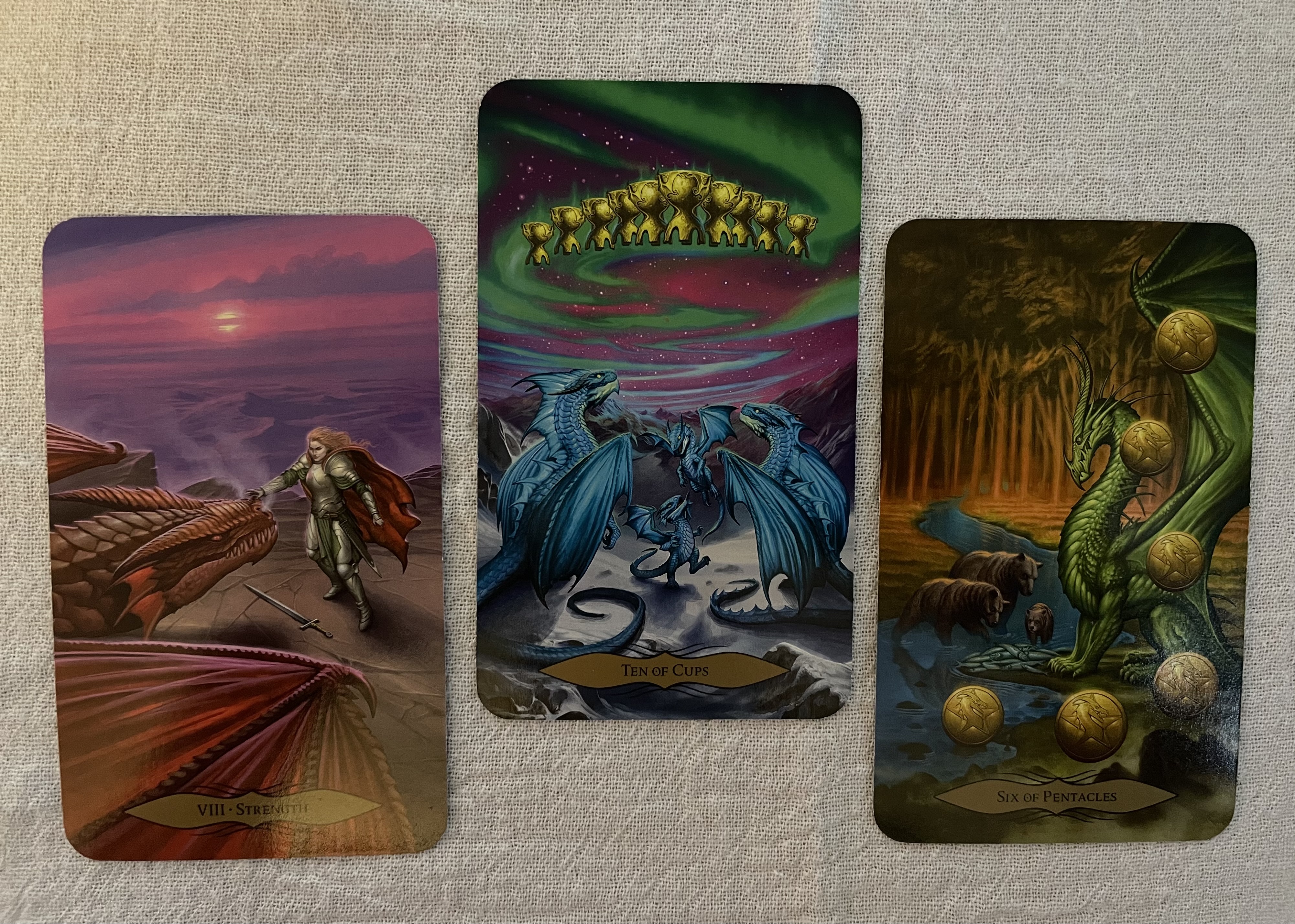
Past: VIII – STRENGTH.
Fortitude can be as benevolent as it is fierce. Under the influence of Strength, it rises not from brawn or blade but from compassion and certainty of spirit. In the direst of times this calms both foe and inner beast and overcomes the reflexive cruelty that comes from fear. Wildness is not tamed but bridged by empathy and offer of trust. Strength is the choice of solace over pain, life over death. The test of the power within. Stand firm, face adversity with open heart and mind and outstretched hand.
There is a saying in draconic circles: The brave knight does not slay dragons, but rides them. The brave dragon does not eat knights, but lifts them into the clouds!
Present: TEN OF CUPS.
Connections are made and complete.
Everyday existence is bright, inspired, and as rich with wonder as the Northern Lights. Family affairs are harmonious and joyful; relationships endure in celebration. Under the arc of the Ten, inner peace and awareness grows. You know that in union, sorrows are lifted, strifes, lessened. That happily-ever-after, though real, is ephemeral. And that family is more than blood. These are the lessons of emotional maturity. Treasure their wisdom; pass them on.
Future: SIX OF PENTACLES.
It is harvest time, and in days of bounty and boon, no one is as generous as the Dragon Lord of the Forest.
Fortunes are restored. But the memory of hard times lingers, and from our memories we learn. Even in the material world there is a quest for balance. Riches serve no one if hoarded, but everyone when shared. After all, how much does one really need? Be gracious and generous. Compassion without action does little good. Spread the wealth and rejoice in watching little things grow. And when the tide turns—for tides always do—cast pride aside and seek help as needed. It will come your way, possibly from a most unexpected source.
Formed in the crucible of the Great War, the creatures of J.R.R. Tolkien’s imagination inhabit very different realms and teach very different lessons.
Dragons and orcs, trolls, fell beasts, and oliphaunts, the epic landscape of Middle Earth is rife with monsters—and heroes—of every shape, size, and disposition. Despite their diversity, most of these beings fit neatly into a black/white fantasy paradigm and are defined—at least on first meeting—by the moral allegiance of their race and the empathy they engender.[1] Nazgûl and wargs are bad; elves and hobbits are good. It’s a simple, useful rule to follow, lest one thinks it might be fun to invite a Balrog to dinner.
Then, all shadowy grey, there is Gollum.
In the pantheon of literary monsters, Gollum is, at first glance, quite unremarkable. He’s not huge or retchingly ugly; he does not go on murderous rampages across the Wilderland or even conspire with the Dark Lord in his bloody campaign to tyrannize Middle Earth. Where Shelley’s creature is all Romantic passions and damaged virtue, Gollum is manic appetites and recreant vice. Totally consumed by his own needs, his Ring-induced self-destruction makes him the 12-step poster boy of fantasy fiction and a very modern monster.
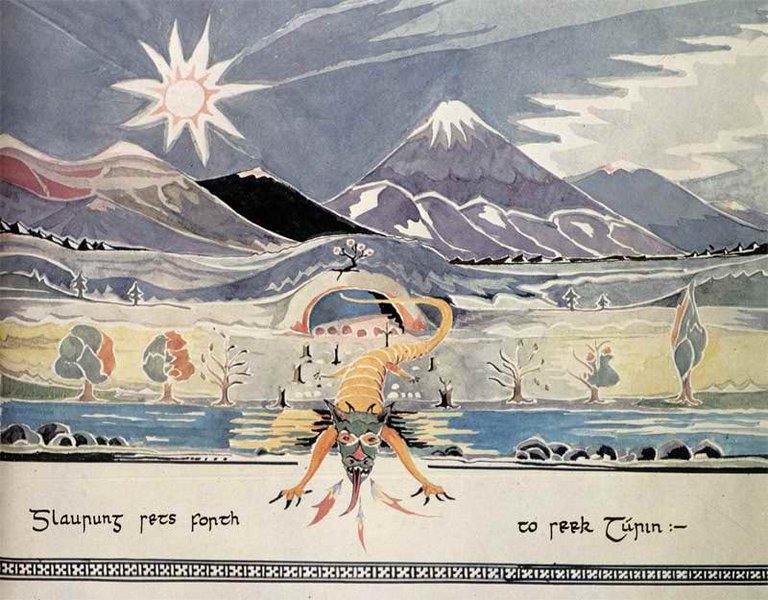
Gollum of The Hobbit is a minor—if instrumental—character, and at first meet, little more than an unpleasant, slimy cypher.
I don’t know where he came from, nor who or what he was. He was Gollum—as dark as darkness, except for two big round pale eyes in his thin face. (The Hobbit, p. 77)
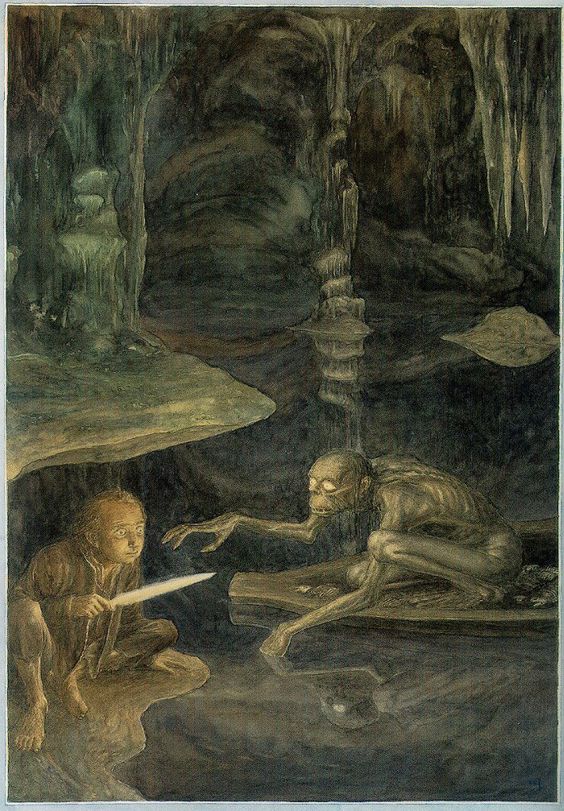
He paddles around the underground island he calls home, dining on blind fish and runty goblins, and talking to himself. Mad as a hatter from isolation and the influence of the One Ring—his Precious[2]—his life is one of relentlessly uneventful survival. As long as he has his Precious and a juicy fish for dinner, he could care less about affairs in the sunny world above.
Then Bilbo Baggins, hobbit and burglar, blunders into his cavernous abode, steals the Ring, and changes everything.
Though Gollum’s present is murky and his future unknown, [3] Tolkien gives us glimmers of a past in what were arguably better times. As he and Bilbo test their wits with riddles, the creature remembers flashes of long ago, of life in the sun, of the taste of chestnuts and smell of daisies, “of days when he had been less lonely and sneaky and nasty.” Most of us would treasure such nostalgic memories, yet they only pain our monster and put him “out of temper.”
Winning at riddles may earn Bilbo directions into the light, but Gollum knows the hobbit cheated[4]and stole his Precious, to boot. He would kill Bilbo for a thief and have him for lunch without a second thought. For his part, Bilbo would spit the creature on his elvish blade if for no other reason than that he’s creepy and uncivilized. But Gollum, “miserable, alone, lost,” is unarmed. For heroes, there are rules about such things.
A sudden understanding, a pity mixed with horror welled up in Bilbo’s heart; a glimpse of endless unmarked days without light or hope of betterment, hard stone, cold fish, sneaking, and whispering. (The Hobbit, p. 93)
Rather than take the creature’s life, Bilbo sheathes his blade. With a great leap, he escapes, the only thing that gave meaning to the monster’s miserable existence tight around his finger. One can argue that hobbit mercy did Gollum no favors.
Which brings us to Tolkien’s magnum opus, The Lord of the Rings.
Like all great epics, Lord of the Rings is a veritable baklava of layered tales. On the one hand, there is the overarching chronicle of the Great Years of the Third Age: destroy the One Ring, defeat Sauron and his legions, and restore Aragorn to the throne of Gondor. Then there are the smaller stories, the human stories of destiny and kinship, courage and foolishness, betrayal and redemption, which put flesh on the bones and make us care. One of those is the story of Gollum and his Precious.
In The Fellowship of the Ring, before Frodo sets a shaggy foot outside the Shire, Gandalf prepares the young hobbit’s way by telling him the tale of the Ring he inherited from his Uncle Bilbo, including what he knows of its previous keeper, Gollum. Forewarned is forearmed, after all, and considering the danger the hobbit is about to face, it is the least a wizard can do.
Briefly, the story goes like this: Over 500 years ago, a simple Stoor hobbit named Sméagol lived with his grandmother, on the banks of the Great River. He was bright and curious, always looking down at roots and deep pools, into the beginnings of things. One year, on his birthday, he and his best friend, Deogol, went down to the river by Gladden Fields. While Sméagol explored the banks, Deogol angled the afternoon away until a great fish took hold of his line and pulled him into the water. There, shimmering in the riverbed, he finds, the long-lost Ring of Power. Now, the Ring makes people do terrible things, and, within minutes of being in its presence, Sméagol murders his friend and seizes the gold band for himself. After all, he’s the birthday-hobbit and it’s his present. His Precious. But there are consequences to these actions, as Gollum explains with pained, cinematic concision in Peter Jackson’s epic adaptation:[5]
…They cursed us, and drove us away. And we wept, Precious, we wept to be so alone…And we forgot the taste of bread…the sound of trees…the softness of the wind. We even forgot our own name. My Precious. (TheLord of the Rings: The Return of the King, 2003)
This is Monster Devolution 101. Shunned by his nearest and dearest, the hobbit becomes a junkie slave to the coercive force of the Ring. As Gandalf explains, it eats into his soul; he hates his Precious and loves it, just as he hates and loves himself. Bit by bit, Sméagol disappears—transformed body and spirit—and a monster emerges: Gollum. “Gollum.” It’s not even a name, just an absonant croak—“gollum, gollum”—as if something foul got stuck in his throat. Surrendering his identity is the ultimate severance from his past, the culmination of his metamorphosis. From that point on, Gollum is the face of weakness, evil, and lies. He is the personification of addiction and the madness that comes from the attendant loss of will. Yet Gandalf suggests that even one as wretched as Gollum has a part to play in the monumental events about to unfold, and the wizard is always right.
Since his run-in with Bilbo, Gollum has spent decades stoking a powerful—literal—hunger for Bagginses. In the throes of full-blown Precious-withdrawal, he’s scoured the caves and crannies of Middle Earth, searching for the slightest trace of his Ring. Or the furry-footed thief who took it. By the time he meets up with Frodo and Sam, he’s lived on Baggins-hate for so many years, that he’s jonesing to rip the Ring from Frodo’s neck and feast on raw halfling liver! The hobbit may not be Bilbo, but, as long as Gollum gets his Precious, any Baggins will do.
So, how do you solve a problem like a Gollum?
For Sam, Frodo’s protector, it is simple: run him through. Even at his most obsequious—and Gollum is nothing if not toady—the creature is as repulsive and dangerous as he was when Bilbo met him. It doesn’t matter who he was centuries before or how pathetic he seems now, Gollum is a monster and that’s all he ever will be to Samwise Gamgee. This may be a very black/white perspective, uncomplicated by the toxic touch of the Ring, but if it keeps Frodo safe, that’s all that matters. With death lurking behind every rock, you do unto monsters before they do unto you.
Once upon a time, in the snug certainty of the Shire, Frodo would have agreed with Sam, but our hero no longer has the luxury of such dichromatic thinking.[6] He is the Ring Bearer, now. The savior of Middle Earth. He looks at this wizened, tortured monster and sees not a foul devil, scraggy and bug-eyed with vile cravings, but a cursed hobbit, tormented and alone, changed under the bane of the Ring. He sees…himself. They are fellow travelers at different points on the same destructive journey, and Frodo is only a dwarf-toss away from being just as broken as Gollum. But for the constant support of Sam, the faith of Gandalf and the fellowship of the Ring, and the warm memories of Shire life, he too could lose his hobbitness.
Frodo needs Gollum, not just as a guide through the Dead Marshes, but as a guide through the hazards of the Ring. He needs to believe that some bit of Sméagol survived the Ring[7] so he can believe he can survive it, too. Save Gollum, save himself. If he can only reawaken the creature’s inner hobbit!
To this end—and over Sam’s many objections—Frodo decides to put Gollum through monster rehab. Treat Gollum like Sméagol, he presumes, and Sméagol might return. He calls him by his proper name, handles him with patience, mercy, and as much trust and kindness as he can muster, all in effort to tame the beast. For a while, the plan seems to be working. Though hardly fit to invite for a pint at The Green Dragon, there are moments in Frodo’s company when glimmers of the old Sméagol break through. When he recalls how good it is to not be alone.
Unfortunately, weakness defines Gollum’s monstrosity, and his hunger proves stronger than the kindest word or warmest memory. Like peat-laced Scotch placed smelling distance from an alcoholic, proximity to the Ring whets his addiction with a wicked contact high. Despite Frodo’s worthy efforts, the creature’s loss of will and hatred of ‘hobbitses,’ come flooding back with a vengeance, turning Gollum/Sméagol into a textbook dissociative personality. Under less Tolkienesque circumstances, an intervention followed by lengthy stay at Austen Riggs would be in order, but there is no such healing on the trail to Mordor, The monster is on his own, slouching towards his inevitable destruction.
Sam is right: the creature’s murderous duplicity remains unchanged, while the conflict between inner hobbit and outer monster makes him crazier than ever. Gollum doesn’t care about good or evil, old battles or future world orders. He only cares to seize his Precious and survive. That means he must suppress Sméagol and separate Frodo from the “nassty hobbit,” Sam. And he almost gets away with it, in part because Frodo so desperately needs to believe Gollum has been tamed, his inner hobbit restored. The more we need our monsters, the blinder we are to their dangers.
Luckily, Frodo has the best subaltern in Middle Earth, Sam Gamgee, watching his back. Neither gulled by Sméagol’s deceits, nor doubting the innate strength and rightness of Bagginses, Sam never gives up on Frodo no matter how wild-eyed and distant he becomes. He tells stories, sings songs, lights every shadow on their journey with memories of hearth and home and the convivial camaraderie of Hobbiton. With uncomplicated devotion, he refuses to let Frodo be alone in the dark.
Yet even the healing remembrance of days past fails under the continued burden of the Ring, becoming more and more fleeting until, at the base of Mount Doom, it abandons Frodo entirely.
…I know that such things happened, but I cannot see them. No taste of food, no feelof water, no sound of wind, no memory of tree or grass or flower, no image of moon or star are left to me. I am naked in the dark, Sam, and there is no veil between me and the wheel of fire. (The Return of the King, p. 264)
This is the legacy of the Ring: the divorce from all things human, the gnawing hunger, and growing lack of will. It places Frodo at the tipping point of monster devolution. Only one more lost than he can halt his descent. Once again, he needs Gollum.
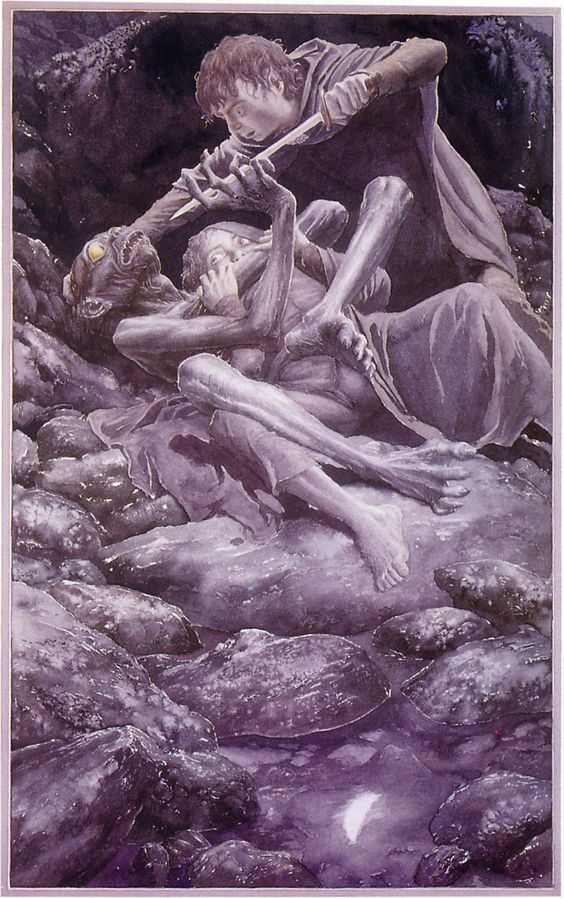
The Gollum who stands at the Cracks of Doom is a monster transformed. His once formidable physical strength has left him. Mad with desperation, he is a strung-out, skeletal creature, his “shrivelled mind and body” tortured by the agony of his addiction, “driven by a devouring desire and a terrible fear.” Running out of time and patience, he will do anything to wrest the band from the halfling’s possession and get his fix. Ultimately, this blind determination—coupled with a set of very sharp incisors—breaks the Ring’s hold on the hobbit and frees Frodo from the growing monster within.[8]
With a fiercesome chomp, Gollum takes the decision to destroy the Ring out of Frodo’s hands. Pathetic, amoral,[9] and rabid with nihilistic abandon, the monster lifts the impossible onus from the hobbit’s shoulders then tumbles into unintentional heroics. Alone in fiery death, he fulfills Gandalf’s judgment and his own redemption.
But for him, Sam, I could not have destroyed the Ring. The Quest would have been in vain, even at the bitter end. So let us forgive him! For the Quest is achieved, and now all is over. (The Return of the King, p. 277)
No life, however tortured, is a failure if it ends in forgiveness.
Over the past few decades, smaller, more egocentric woes have replaced the primordial struggles and grand romantic dreams of yore, and our monsters have shrunk accordingly, fitting neatly into the mote in our neighbor’s eye. Ancient though he seems, Gollum is a monster for this new age. Flawed and vulnerable, with the fortitude of a jellyfish and a Me-Generation sensibility, he is the fleeting image we catch in the mirror, the dread grotesque lurking inside us all.
The modern world is awash with Frodos and Gollums, ever vigilant lest the darkness of the one subsume the light of the other. They’re easy prey, more scared than scary: the bullied outsider at school, the parent with three kids, no job, and an eviction notice in hand, the misanthrope who lives at the end of the lane; people damaged, humiliated, driven to the outskirts of life, looking for fairness in an unfair world. Alone at the crack of doom. It doesn’t take a magic ring to nudge them over the edge into doing terrible things. Not today.
And when one falls, when the darkness wins out, we hang the epithet “monster” about their neck, and throw up our hands in horror. They were our coworkers and classmates one minute, aberrant beasts the next. It’s a comforting way to order the world. We don’t have to look within, to admit our kinship or question our hand in monster-making. Simply deny them their humanity and the solace of moral superiority is ours. We could never be like them. We are the white hats, the God-fearing “good guys with guns,” loved by family and friends, respected by society, safe from our inner daemons. We’re not other. Not evil. That’s our story and we’re sticking by it.
Tolkien has presented us with a template for our future monsters, for those that fester within, pustules of malevolence simmering just beneath our frail human skin. The Gollums of the world are a challenge to our humanity, and if they teach us anything, it is that modern evil, much as we want to call it beastly and thus divorce ourselves from its reality, is, at heart, not monstrous at all. As Hannah Arendt insisted during the Eichmann trial of 1961, the true danger of evil is that it’s human and common as dirt. Violence, regardless of its jingoistic spangles, is the eternal curse of our species. It is reflexive, unimaginative, and utterly banal. [10] It is Us, in all its Pogo-esque glory.
So. These are our monsters, gargantuan and puny, human and divine. We carved their bones in solitude and layered them with the flesh of hostility and disaffection, each generation getting not only the monsters it needed but also those it deserved. When headlines erupt with the latest atrocity, and a new crop of monsters claim their fifteen minutes of fame, we hug our loved ones a little closer and promise to be better people. And in the shadows before sleep, we pray to gods—old and new—that, in the end, we can remain the Frodos of our imagining, standing in the light.
Only then can we welcome monsters into our hearts where they belong, where they can teach us their final lesson: that we alone must bear the moral burden of our actions.
[1] As in any tale, perspective has its place, too: orcs, for example, always consider ents monstrous, but only a psychopath would agree with them.
[2] Note: “Precious” is also how he refers to himself and occasionally others.
[3] What we know of Gollum today is considerably more than was found in the original manuscript. As The Lord of the Rings took shape, Tolkien rewrote parts of The Hobbit to bring the mythos and characters more in line with their later incarnations. Gollum’s chapter, “Riddles in the Dark,” was noticeably altered, with bits of the original kept as a lie Bilbo tells Gandalf and the dwarves to explain his having the Ring.
[4] Likely the first sign of the Ring’s corruption. The riddle game is sacred among hobbits. While Frodo later insists that Gollum was surely planning on cheating all along, it was Bilbo who actually did.
[5] Jackson chose to put this at the beginning of the last part of the trilogy, The Return of the King, instead of in The Fellowship of the Ring. In the gamut of directorial choices, this is relatively minor and might even make sense, though I can’t help wondering if Frodo and Sam would have treated Gollum differently had they known his story before meeting him.
[6] In his most recent cinematic incarnation, Frodo is much more generous to Gollum than in Tolkien’s books. Though not the doubting Thomas Sam is, Frodo of the page uses the creature but remains skeptical. Sméagol did, after all, begin his ring-tenure with murder.
[7] It helps that Gandalf put such great stock in the solid goodness and slow incorruptibility of hobbits; that the wizard held out hope, slim though it might be, for Gollum to be cured of the Ring’s hold before the end. To play a part in the battle for Middle Earth.
[8] Of course, fighting monsters, especially those so close to us, has its cost, and Frodo pays heavily. He carries scars inside and out and pains gripping his heart with a perpetual shadow for all his days. Some lessons are harder to bear than others.
[9] Gollum does not have sufficient volition to be actively evil.
[10] See Hannah Arendt, Eichmann in Jerusalem: A Report on the Banality of Evil (New York: Viking Press, 1963).
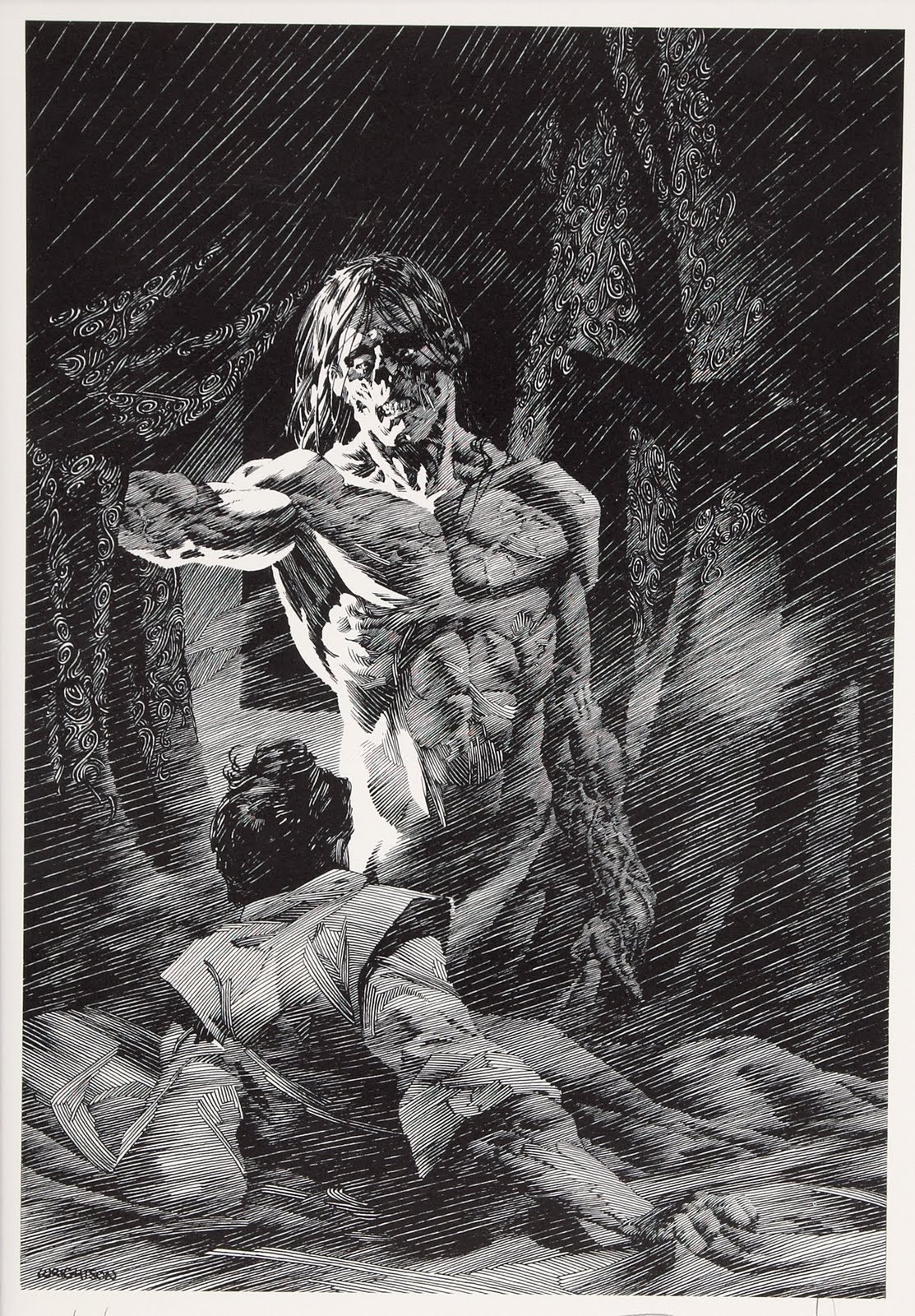
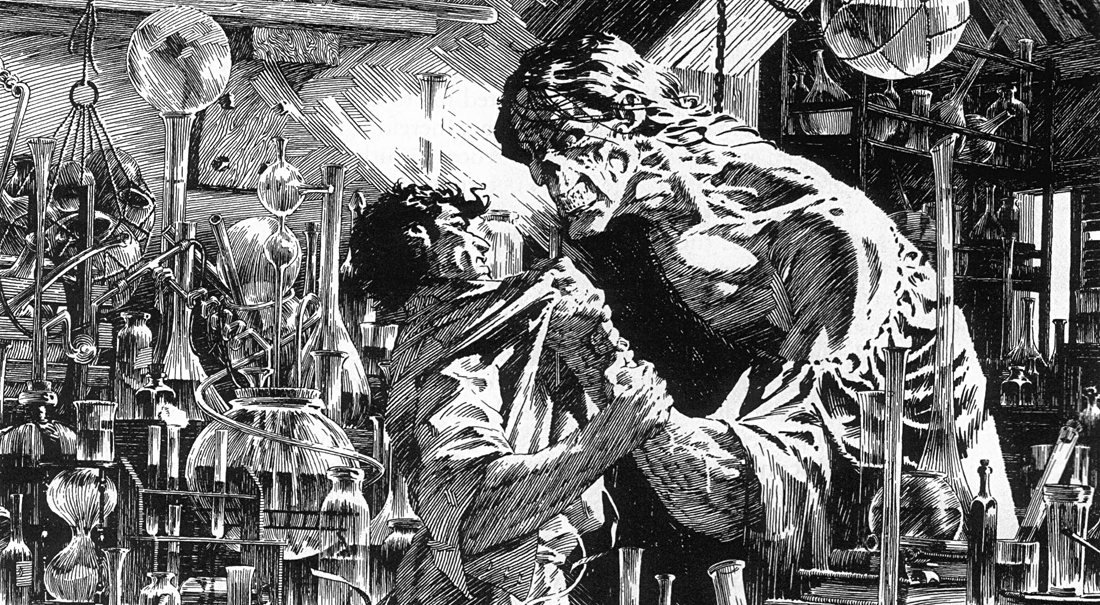
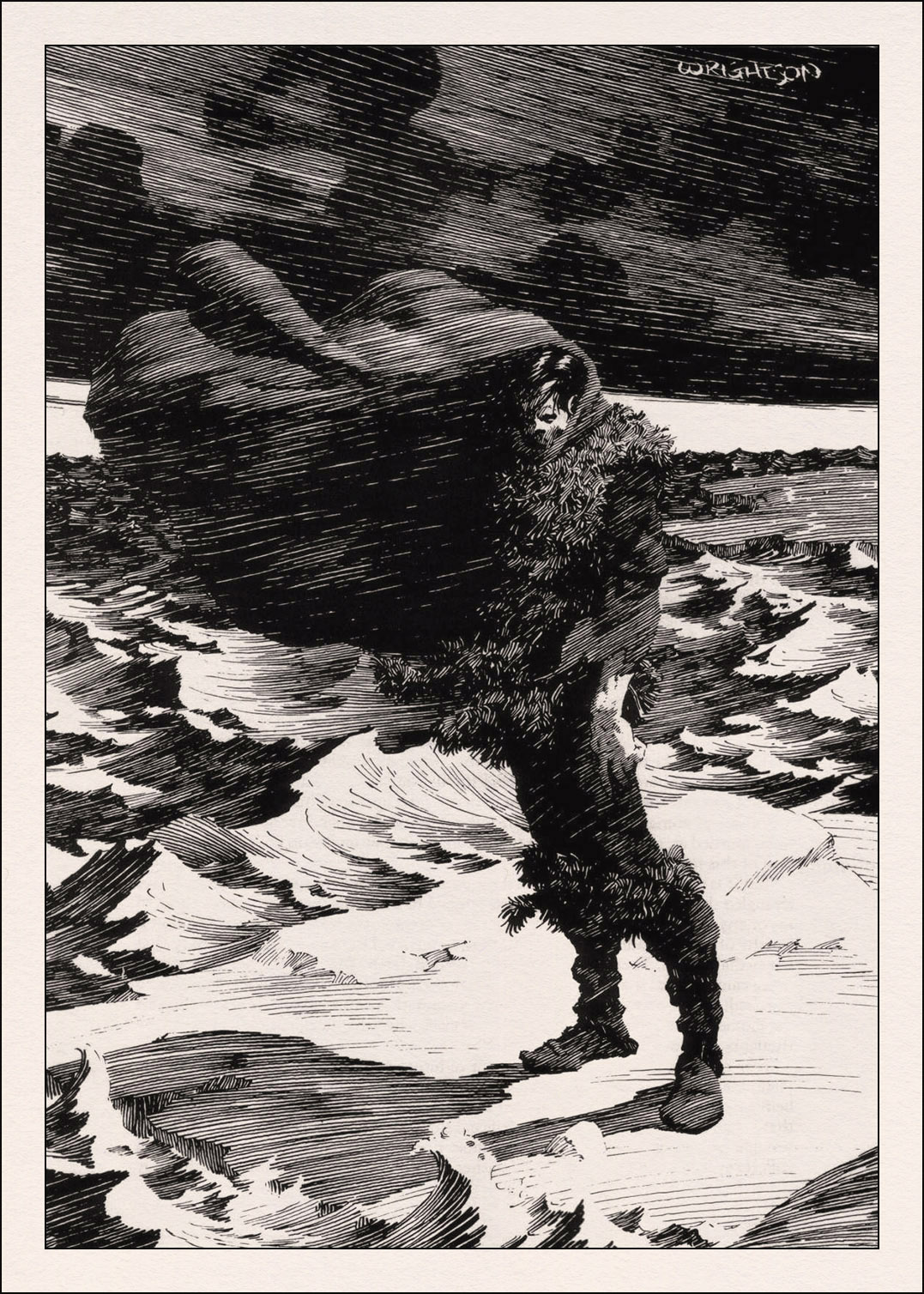
If the creature broke the man in Moby-Dick, then the man broke the creature in Frankenstein. Mary Shelley’s 1818 novel is a classic of science, morality, and the horror that comes from arrogantly playing God.[1][illustrations by the late, great Bernie Wrightson]
It is also, first to last, a tale layered with the exquisite agony of love, loneliness, and loss, a paean to the need for affection and sharing between souls, to being able to look into another’s eyes and see one’s worth mirrored back without judgment or fear. For this, in the end, separates the men from the monsters.
What a piece of work is Victor Frankenstein! A man of shimmering intelligence and infinite curiosity, and enough hubris to give Sophocles fits. He is the epitome of the romantic hero, blessed with all the gifts and idealized virtues of his class and just enough childhood distress to spark our empathy and make him accessible. In short, Victor is every man’s peerless friend, every woman’s perfect lover,[2] and when he falls—as all tragic heroes must—his misfortunes are “great and unparalleled” as befits his nature. He is also a man of erratic tempers and obsessive passions, who, when he loses control, trusts—consciously and not—that his loved ones will always be there to restore him to his nobler, gentler self. As he tells his arctic rescuer,
…we are unfashioned creatures, but half made up, if one wiser, better, dearer than ourselves—such a friend ought to be – does not lend his aid to perfectionate our weak and faulty natures. (Frankenstein, p. 25)
Of course, he says this at journey’s end, after years of suffering and fear and violence, when he has lost all and knows only the emptiness of pursuit and despair. Once upon a time, an awareness of this defining human need would have made a real difference to the arc of his existence, but young Frankenstein could not see it. He was more concerned with his Promethean[3] dreams of defying the Gods and creating a new race of beings, titanic in form and function.
A new species would bless me as its creator and source; many happy and excellent natures would owe their being to me. No father could claim the gratitude of his child so completely as I should deserve theirs. (Frankenstein, p. 42)
Now, as any parent knows, the responsibilities of creatorship far outweigh its perks. Unfortunately, Victor craved all of the latter and none of the former. He played with the forces of life and death yet, when the result wasn’t the golden child he’d imagined, he shattered the paternal covenant and ran.
We who like our heroes charming and our monsters ugly will probably relate to this, but Shelley does not make it that simple.
Victor’s “fiend”[4] is no grunting hulk, lumbering through the countryside; he is a complex, three-dimensional being. Granted, he’s never going to be the centerfold of the Schweizer Illustrierte, but “his limbs were in proportion” and Victor had originally “selected his features as beautiful.”[5] That he did not turn out that way was hardly the creature’s fault, and, like the rest of us, he is so much more than the sum of his external parts. With a quick mind and a spirit that would make any parent proud, he’s resourceful, articulate, and better read than many an American college student. No thanks to Frankenstein, he learned to value virtue and hate vice, value peace above war and justice above inequity. Vicariously he experienced affection and happiness; he gave to others, eased their burdens without expectation of return. Like any other man, he thought and felt, he longed for companionship and its joy. As he tells his maker, “I was benevolent; my soul glowed with love and humanity.” Had he a father who cared for him, taught him, kept him safe, he might have become the transcendent being Victor imagined.
Unfortunately, Frankenstein is the product of a Romantic Age in which appearances count. His ideals are exquisite, his ambitions lofty. How could such a man look upon the nascent convulsions of reanimated flesh, the raw light igniting sallow eyes, and see anything but the ghastly, damning imperfection of his hubris? To his aesthetically bound preconceptions, Victor brought not a man back from the dead, but a daemon. Horror so overwhelms him that he cannot bring himself to spend a moment in the creature’s company, let alone try to imagine the depths of his soul. He does not even give his child clothes or teach him the basics of survival. The panicked papa, too craven to aid, too proud to destroy, simply tosses the misbegotten scion of his labors to the hostile world, frightened, lost, and alone.
Thus, on that rainy November night, our shiny hero begins to tarnish. Where youthful chutzpah drove him to create life, cowardly choices thereafter—decisions based on fear, self-loathing, or willful neglect—result only in misery and death. Frankenstein’s abject flight and subsequent years of hiding and betrayal do more to beget a monster than all his sleepless months in the lab.
But Monster Who? Creation or Creator? Who earns our sympathy?
I side with the creature, the ultimate outsider, arguably more sinned against than sinning. At least at first. In his short life, he knew abandonment, anguish, pain, and dread. Like lame Hephaestus, he was thrown away not for the virtues of his character, which were many, but for the vices of his form. Though damaged and despised, he somehow still finds a way to love life and marvel at the wonders of the world. From the depths of his aloneness, he understands the obligations of a creator better than he who made him. When, after many years, they meet, he lays out his case for a debt owed:
Frankenstein, be not equitable to every other and trample upon me alone, to whom thy justice, and even thy clemency and affection, is most due….I ought to be thy Adam, but I am rather the fallen angel, whom thou drivest from joy for no misdeed. Everywhere I see bliss, from which I alone am irrevocably excluded. I was benevolent and good; misery made me a fiend. Make me happy and I shall again be virtuous. (Frankenstein, p. 78)
With impeccable logic and passion that would thaw the coldest heart, he bares his life to Victor, then asks him for the gift only he can give: a helpmeet, fashioned as he, to share his life and ease his wretched existence. In exchange, he promises to vanish from the world of men, go deep into the South American wilds, and there live and die, perhaps not happy in human terms, but “harmless and free from the misery” he feels. Though backed by a threat of violence, it is a reasonable request and no more than his due. “Let me feel gratitude towards you for one benefit!” he pleads.
O, how a fiend does teach the rules of godhood! One would have to be made of stone to resist such an entreaty, and, for all his failings, Frankenstein is not that. Unfortunately, he is also not the benevolent maker his creature needed.
Samuel Butler wrote, “Oaths are but words, and words but wind.” Though Victor swears to make an Eve for his Adam—and knows well the price of betrayal—once out of the monster’s sight, his words blow thinner than a summer breeze. Haunted by past wrongs and future nightmares, Victor runs. Again.
Not that we’re surprised. At this point, it is almost as if he can’t help himself. Free of the monster’s persuasive rhetoric, he can hear only the threat of death and destruction pounding in his ears. His life has become so full of fear, distrust, and guilt, he cannot grasp that one so monstrous outside could possibly be so virtuous and human inside. Revenge from a daemon is easy to understand, but not forgiveness. Because he cannot get past his own prejudices, he damns the monster to a life of anguish and solitude and has the gall to call him “treacherous.” Every agony, Victor brings upon his own head. Every drop of blood shed by his loved ones, flows over his hands.
To some, Frankenstein’s decision not to bring another revenant into the world will appear noble, even self-sacrificing, given the cost. I see it as both dishonorable and foolish. The creature offered peace, yet, once Victor chooses to vitiate their agreement, potential gratitude turns to absolute hatred. Betrayed yet again, the monster makes good on his threat, cutting out his maker’s heart with mayhem and death from Switzerland to the Orkneys and back again. He keeps his word.
The scales balance. Frankenstein finally feels the persecution and torture his creature felt his entire life.[6] Of course, hampered by a hero’s perspective, he blames the beast rather than accept the passive-aggressive role he played in his own destruction.
Wretched and despairing, with neither family nor friends to soothe his passions, he travels the world, mad as Ahab, surviving year after year on a diet of vengeance and rage. The monster’s execution is his raison d’être, and should he die in the process, so much the better: his misery will cease and he’ll no longer have to face life alone.
When the end comes, monster and man, by turns hunter and hunted, are almost indistinguishable. I say almost because, to this reader, the creature seems more human, more self-aware, more forgiving than his maker. Damaged as his form might be, his conscience always remained intact, remorse always gnawed at his soul. He not only comprehends the fullness of his crimes, but knows that each blow, each act of revenge, no matter how provoked, diminishes him ten-thousand times more than his “self-devoted” foe. Atlantean to the end, he shoulders his responsibilities and welcomes death with the grace of self-determination.
Like all good monster stories, Frankenstein is a cautionary tale. Maker and monster are emblems of raw knowledge and the disasters of parental neglect. Of getting so obsessed with being able to do something that one forgets to question if one should. Two hundred years old and it remains a story of the future, of forcing the evolutionary arc of nature because it seems a neat idea at the time. Cloning, drugged and irradiated plants and animals, fracking, GMOs—Jurassic Park is simply Frankenstein with dinosaurs! We continue to plunge ahead, pushing the limits of scientific possibility sans critical reflection, without stopping to ask if this way monsters lie. And when they show up—as they surely will—do we do better than Victor Frankenstein did, or, ignoring the horrifying lessons of his tormented creature, do we simply hold our breath and stumble cravenly on?
[1]Much as I love James Whale’s 1931 film, it lacks the nuance and depth of the source. Kenneth Branagh’s 1994 version sheds the charm of the earlier film for shock value and misses major points in the process. Despite the vaguely steampunk flourishes, in their current TV incarnations on Penny Dreadful, Frankenstein and his creature hit very close to the mark.
[3]At first blush, Shelley is obviously referring to Frankenstein in her subtitle, “The Modern Prometheus,” yet, given the literature of the time, one can see the Creature fitting the bill, too. In 1789, Goethe, an influence on both Shelley and her fictional scientist, published his poem, “Prometheus.” In it, the Titan rails at Zeus: “When I was a child/And did not know where from or to,/I turned my seeking eye toward/The sun, as if beyond there was/An ear to hear my lament,/A heart like mine,/To take pity on the afflicted.” Frankenstein’s monster would have concurred.
[4]In the tradition of anonymous faerie-tale antagonists, he is called fiend, daemon, creature, devil. Frankenstein does not even deign to give his child a name.
[5]Let’s be honest, though: what newborn is ever pleasant looking save to the most adoring parent?
[6]Naturally, given his romantic narcissism, his suffering is worse than anything his creature could possibly have endured and so his rage the more justified. Or so he tells himself. Where would we be without our rationalizations!
Dragons are change; change is life. This is a fact all dragons understand and so, unlike many of us, they embrace change rather than fear it.
Like a plumed flying fox, all healing gold and innocent white, the Hanged Dragon is suspended from a rainforest bough, his feet bound fast by verdant vines. Can he break free? Of course: he is a dragon. But he does not want to. Despite his aspect of suffering and helplessness, he is calm, even serene.
Lured from the forest, a daring jaguar leaps to play with the dragon’s pendent crest feathers—a cat with her cat toy.
The Hanged Dragon is in transition, his life on pause—suspended—while going through a period of adjustment. This is a time of reflection, of letting go so you might connect (or reconnect) with your inner divinity. For the fearful, this feels like a journey into darkness. For the dragon, it is all part of being alive. Allow the Big Picture to unfurl before you, your wisdom to re-align, and your eyes to look upon the world anew. There is wonder in this, serenity, sometimes joy.
As for the jaguar, like all cats, she is a reminder that, no matter the sacrifice or how upside-down the world may feel, we are all—even dragons—Nature’s playthings.
Today we move on from the divine to monsters a little closer to home.
Monsters Fabled and Literary
Today, the familial thread linking monsters with the divine is tenuous at best. Now our monsters are children of the imagination and of the street, and though these new chimeras no longer sport the luster of dying gods, still we follow the ancient formula in their making.
As a writer, I find myself particularly drawn to the macabre and lonely conjurings of the creative mind, from fable to genre tome. An outgrowth of our mythic past, faërie-tales and fables boast two basic monster types: natural creatures out to pounce on the errant, foolish, and unsuspecting, and errant, foolish, unsuspecting humans who have been enchanted.
Natural monsters are a wonderfully diverse lot: dragons, trolls, kelpies, bunyips, and big, bad wolves. They populate woods and ponds and closet shadows, the threat of their lethal clutches keeping unruly children on the beaten path.[1] With the exception of the Bears Goldilocks encountered, we imagine these beings living off on their own—in small bands at most—hostile misanthropes with voracious appetites, just waiting for us to put a step wrong. When we do, these creatures demand feats of reckless—if well-rewarded—bravado, as knights and woodsmen flock to rescue their hapless victims.
The truth of these creatures is more complex, of course. Many are devoted to family and clan, and are simply doing their best to live in a dangerous world. Who the real victims are under such circumstances is open to debate—after all, why should humans be the only species allowed to be fruitful and multiply or stand their ground? Sure, Jack was poor, but that doesn’t justify stealing from the Giant and his wife, and, amongst humans, home invasion is frowned upon even if you are a golden-tressed ingénue.
But these monsters aren’t human; most don’t even have names—all the better to despise and slay them, my dear.
Enchanted people/monsters are cautionary characters of a different stripe, symbolic of a litany of failings, willful and otherwise, that come with being human. Especially a royal human. This is where faërie tales veer into the world of political commentary, shining light on what it takes to be a good prince in a best of all possible worlds. Greed, sloth, and disrespect, arrogance, and ignorance, common weaknesses in ordinary folk become fatal flaws for those to the purple born. Of all people, they should know better and deserve harsh remedial lessons when they forget. In the past, such erudition fell to the gods—the legends of Medusa and Arachne spring to mind. Now it is the province of the faërie. Lord or lady, cross the wrong sprite and you wind up on a whole new learning curve, cursed, beset, besieged, and potentially dead.
So it was with the Beast, the Green Serpent, the Frog Prince, the Laidly Worm of Spindleston Heugh—changlings all, mastering lessons in scale and fur they failed to learn in skin. Hoping, in the end, to be redeemed. Lucky for them, in the tidy fashion of once-upon-a-time, redemption is possible.
No matter how fierce or hideous, these ensorcelled creatures can always be uncursed by love. By someone who steps outside of their own comfort zone—often for the sake of family honor—and gets past their fears and kneejerk prejudices. Beauty liberates her Beast. The Princess (reluctantly) keeps her word and de-amphibifies her saucy Frog. Snow White and Rose Red help the enchanted bear return to his regal form.
All is well until the next time, when another faërie feels slighted and a monster grows in a princeling’s stead, his grisly aspect, like Dorian Gray’s portrait, a constant reminder of his transgressions. He’s driven off and those left behind breathe a collective sigh of relief. They are safe from the ‘other’ in their midst. They can forget. And they do, until through stupidity or greed, someone else stumbles upon the beast, and the whole chain of events—initially dangerous, ultimately miraculous—begins again.
In faërie tales, the cycle continues until we learn; until we see with clear eyes, that monsters are not ‘other,’ they are us. Until we acknowledge that, more than faëries—even more than gods—we are their makers, responsible for all their wonder and terror.
Sympathy for the Monster—Old Forms and Modern Madness
As the Age of Enlightenment folded into an Age of Industry and Angst, we began to do just that, and creatures of anonymous myth and faërie tale started competing with monsters boasting distinctively authored pedigrees. From the Phantom of the Opera to Man-Thing, Moby-Dick to Godzilla, this new breed are amalgams of horror and fantasy, natural and divine, forged in the ancient furnace of persecution and aloneness, yet endowed by their creators with the self-awareness, dread, and dreams of the age. They are stentorian instruments of the author’s voice, mirrors of a maturing knowledge of psychology and growing dis-ease within society and ourselves.
In our progressively alienating environment, we humans recognize the monster—the potential for the monster—within. Alienated souls lost in a modern world speak to us. They inspire our sympathy, empathy, even respect, eliciting by turns admiration and terror.[2] Changelings, demi-gods, massive beasts born of nature and human folly, they still get our adrenaline pumping, even give us the occasional nightmare. Yet, in this strange new literary—and cinematic—world, they also make us think, even re-examine our traditional notions of good and evil. If we give them a chance, we discover, for better and worse, they are more like us than different. Of course, giving them that chance is the hard part.
In print, ink, and on celluloid, the list of non-humanoid monsters is as long as a wyvern’s tail, though a couple stand above the rest. On the cinematic front, King Kong and Godzilla, though of varied origins, are both monsters of the old god-beast mold, yet, unlike their mythic predecessors, they upended the old burdens of fear and villainy and, in the prism of modern sensibilities, became wild anti-heroes. Though outside the normal bounds of nature, they are not inherently barbarous or cruel. Rather, wrenched from their habitat, pained and hunted, they are tormented by forces beyond their control. Often by us. It wasn’t “beauty killed the beast,” but the loss of home and exploitation of the showman; and Godzilla is a voice roaring in the wilderness we choose to obliterate rather than heed.[3] When these more traditional creatures exchange their lot with heroes and victims, different, much more human monsters emerged.
These are the new changlings, humans—or near humans—warped not by some spell of a scorned faërie, but by fate or malignant designs. These are monsters broken and reformed on the rack of loss and obsession. Ahab, Frankenstein’s creature, GollumM of Middle Earth, monsters born in the madness of solitude and self-loathing.
“Ahab?!” you say.
Most definitely. Moby-Dick is a masterpiece of monster fiction, and of course, many consider the whale the monster. For all of Melville’s forward transcendentalist thinking, he was still writing of and for his time. It was the mid 19th century, and God smiled down upon the whalers of New Bedford. Theirs was a noble, lucrative, and extremely dangerous profession. Despite the ominous homilies from Father Mapple’s pulpit, reaping the rich spoils of the sea was a divine right of man. Against this backdrop—and by virtue of his cetacean ways—Moby-Dick, à la George’s Dragon or the Tarasque of Provence, is the logical evil antagonist. In such a scenario, Ahab stands tall, the tragic (anti)-hero, Aeschylean in his single-minded quest for revenge. And even by cynical 21st-century standards, Ahab has his sympathetic points. A man of faith and education, for near forty years he was a bold captain, inspiring loyalty from his men, sharing with them the perils of their chosen life. He even married, had a wife and son, and though we learn little of them, it speaks to his having familial ties. Once upon a time.
Then the bite of an alabaster leviathan flensed him clean of his better self, and he took on the changling’s mantle, becoming a man transformed by loss of limb and pain of flesh. Yet Moby-Dick was hardly unscathed by their encounter: for years he’s borne the misery of the whaler’s “fiery darts,” festering beneath his skin. Is Ahab’s torment so much more because he is human? Or is it his monstrous flaw that, as a human, he cannot let it go? As he turtles within himself, his hatred grows. In the end, he hunts Moby-Dick round perdition’s flames not because he is a whale, nor even because he took his leg. He would slay Moby-Dick because he is the symbol of the darkness worming into Ahab’s heart, the loneliness filling Ahab’s head.
To a 21st-century whale-hugging reader, all this seems a bit over the top, and for good reason. Moby-Dick is a marvel of nature, an ancient of his kind as wild and mysterious as the depths he sounds. The singular and majestic best of his species, his alliance is neutral; the only malice in him is that consigned by his would-be executioners. If he had his druthers, he’d no doubt delight in cruising the seven seas, dining on giant squid, perhaps fathering a pod or two of whale-lets and being left alone. Instead, he must run before ships and harpoons, away from waters red with the blood of thousands of his kin. It is a curious universe in which one peg-leg outweighs so much slaughter.
In human terms, Moby-Dick was acting in self-defense. He sought to flee the tenacious Pequod, but when that failed, he stood his ground.[4] Ahab may have seen the creature as “possessed by all the angels that fell from heaven,” showing “retribution, swift vengeance, eternal malice…in his whole aspect,” but that was a projection of his own murderous intent and purpose. The White Whale mirrors Ahab’s broken self-loathing, and that is an image he cannot abide.[5] This is the fine madness that turns heroes—and ordinary men—into beasts.
NEXT WEEK: FRANKENSTEIN
[1] Hans Christian Andersen’s “The Girl Who Trod on a Loaf” used to give me nightmares!
[2] Remarking on his 1946 film, La Belle et la Bête,Jean Cocteau said his “goal was to make the Beast so human, so likeable, so superior to man, that his transformation into Prince Charming would be for Belle a terrible disappointment.” He succeeded so well that—according to apocrypha—upon seeing the film, Greta Garbo cried out, “Give me back my beast!”
[3] Though somewhat childish in intent and execution, Monster Island was one place where Godzilla, Mothra, Rodan, et al. knew the companionship of their kind and were able to live in peace. Of course, that was messed up for them, too.
[4] And 23 of these United States would back him up on this.
[5] One is reminded of Seneca who said that monstrum, like tragedy, is “a visual and horrific revelation of truth.”
FOUR OF PENTACLES – As the sun filters through a warm autumn wood, aged trees branch protectively over a hillside lair. A large green dragon lolls on the lichen-covered roof, his tail draping casually across the shadowed opening. This is his place of ease and power. Where he feels at home. A trio of pentacles litter the forest floor while he grips a fourth in his paws. Fast. As fast as his belief that what he can hold, he can claim. Ownership is all. For good or ill, he finds security in the stuff of his world.
In the material world, success equals wealth, wealth leads to possessions. And possessions bespeak power. The Four of Pentacles is replete with all three. Hold tight to what you have; there is security in affluence and power and the rule of castle keep. For a time. But hold too tight, and castles become cages for misers and tyrants. Uneasy lies the head that wears that crown. Learn to let go and be generous. You will sleep much better.
We’ve been out of pandemic lockdown for some time now. Thank the Great Dragon and the efficacy of science. And yet, as I look around and read the news, there seem to be so many of us still unable to break out of COVID-isolated lives. Not good.This way sadness, madness, and monsters lie.
Which leads me to sharing a piece I wrote a while back,inspired by a poignant image I saw years ago of Godzilla.
The Loneliness of the Long-Distance Monster – Nightmare Creatures: How We Make Them and Why We Need Them is a lengthy essay so I will be posting it sections starting today and on the next few Saturdays.Enjoy.
THE LONELINESS OF THE LONG-DISTANCE MONSTER
PART I
During our oh-so-brief tenure on this planet, we have populated land, sea, and sky with a motley array both divine and terrible. From the bowels of our subconscious, we’ve summoned the stuff of myth and legend, heroics and nightmares. Gods and Monsters with barely a hair’s difference between them.
Not that this is surprising. Given the constant ebb and flow of religious tides, one person’s god becomes another’s monster—and vice versa—in the flick of a centicore’s tail.[1] As Joseph Campbell said, “What we call monsters can be experienced as sublime.”[2] It all depends on the eyes we use.
Despite the ambiguity inherent in such a personal perspective, we tend to place gods above monsters in the cosmic pecking order. Even at their most cruel—and they are cruel—gods are held up as bright and shiny forces, central players in the Big Picture. Supernal world builders and surly avatars, they raise mountains and harp about parochial morality, chiding us for our god-given inadequacies. They are also the ultimate shakedown artists, demanding offerings, adulation, and obedience in return for a sucker’s chance at divine protection. From the elements, cataclysms, and plagues. From monsters lurking in the shadows, dark, grubby, and dangerous.
Personally, I’ve always had more use for monsters than gods.
Where gods make us small, monsters make us noble and heroic. Where gods can make us feel irrelevant, monsters give us purpose. With flash of fang and deafening roar, they trigger adrenaline rushes that can make us feel positively demi-deific. The fear monsters—rightly or wrongly—inspire demands we stop waiting for divine intervention and take responsibility for our own safety. That we rise above the mundane and shine like beacons in the dark. That we count. But they do more than that. Monsters remind us what it takes to be human.
And for all that, they ask nothing of us save the one thing we deny them: that we leave them in peace. They deserve better.
They deserve reverence and understanding of their purpose and origins—of how we make them and why.
OLD GODS—NEW MONSTERS
There is a fine art to making gods, one that demands curiosity, imagination, and the care of generous spirits. Most of all, it demands a massive dose of wonder.
Back when scientific understanding was as rare as feathers on a wombat, creating gods was a way to explain not only how we got here but also the inexplicable flourishing all around us. Earthquakes, tempests, fire and flood, night and day, life and death,
Our early efforts at [explaining the Universe] led us to look around and elevate the known to the unknowable. We stomped smooth the dancing ground of the gods, imbuing vast creative—and conversely, destructive—powers in heaven and earth, beasts, birds, and elementals with sacred worth. From whatever was at hand, we fashioned the gods who fashioned our world. (The Dragon Keeper’s Handbook, p. 122)
These early gods were literal movers and shakers, dynamic powers more than equal to the task of shaping a dangerous world. Many were majestic zoomorphic hybrids, larger than life and wild as the centuries are long. They inspired fear as readily as veneration, nightmares as readily as prayers. And why not? Primordial Earth was a scary, untamed place full of rapacious predators and mind-boggling natural phenomena. We needed chthonic deities more ineffable than the darkness they ruled, tutelaries more badass than the feral forces they battled. We honored them in their wildness with offerings and praise, and, though size and nature made them hard to keep physically close, we kept them close in our hearts. They, in turn, kept the natural world at bay and in balance, light and dark. They were the gods we needed at the time. Gods who were not us.
Then we changed our ways. We learned to tend fields and herds, erect palisades and walls of stone. We fashioned letters and numbers and aspired to be civilized. Natural balance gave way to a sense of human entitlement and dominion. This tamer new world no longer fit gods who could blot out the sun and play catch with the moon. We needed domestic gods for a domestic world, deities with familiar faces who would not be out of place sharing hearth, board, or even bed.
So we built a cosmic fun house and tumbled through the nearest looking glass. New gods sprouted all around, essentially us, but more so. While still titular overseers of natural realms,[3] they took on abstract concerns as well, like truth, justice, wisdom, and virtue, and strictly human worries, like medicine, marriage, harvest, and war. Like us, they had extended families—cosmically dysfunctional ones, as a rule—and were as fond of a feast as the next man. They advised heroes, scolded reprobates, and strengthened the blood of royals with their own.[4] There was sacrifice and redemption, miracles and capricious cruelty. At best, they were our idealized selves, strong and wise, beautiful and loving, goodness personified and wrapped in celestial clouds we could only navigate in our dreams. At worst, they were carnival grotesques, petty and egocentric, scrappy and earth-shatteringly jealous. Some might even say diabolical. In short, human.
While we were making nice with these divine reflections—or at least trying not to piss them off—what happened to the old gods? The wild and woolly beings who’d kept us safe for so long?
Used hard and well, the ancient gods suddenly[5] found themselves dragons in a gecko world, too rough around the edges for civilized company.[6] They were embarrassing reminders of our fearful, lizard-brain selves, their once majestic wildness deemed accursed and vile, ugly along side deities who share our personal aesthetic. We took their wondrous feats—and our affections—and handed them to the new gods. Then, replaced and unwanted, we tossed the old away. Without so much as a “thanks for all the fish,” we burdened them with our darkest fears and impulses; we stole their grace and blackened their souls. We turned them into monsters.
If making gods is a noble exercise, making monsters is a much darker, more sinister endeavor. It is an act of ungrateful cruelty and willful neglect. Judgment, castigation, persecution, aloneness. These are the elements of monster-making burnished through the centuries in rivers of monster blood. But greatest of these is isolation.
Where gods stand apart, monsters must be set apart. We drove the old deities out beyond city walls, far from offering and hymn, from their place in the light. We stripped them of families and friends, of the joy of companionship. Of purpose and name. We demanded they face eternity alone.
To those used to bustle and flurry, to the warm adoration of multitudes, such cruel isolation must have been agony. Just look at the madness visited upon humans in solitary confinement! And when these beings began to act like monsters (surprise!), a dichromatic, us-vs-them dynamic took hold. Denying our role in their making, we hunted them down and slew them with impunity, proof of our might, right, and loyalty to the new. True, a few have survived, living on isolated pockets of old-school belief. But they are anachronisms in the 21st century and, like the gloriously primordial monster in the 2001 film, No Such Thing, find a friendless eternity too much to bear. Taking their fate into their own hands, they choose to fade away rather than struggle on in a world that no longer wants them.
[1] Dragons, in particular, experienced this transformation innumerable times over millennia, going from masters and makers of the universe to malevolent beasts in the blink of a cosmic eyelash. They never asked for any of this, but we thrust it upon them all the same.
[2] Joseph Campbell, Power of Myth (New York: Doubleday, 1988) p.222.
[3] The elements were no longer literal deities, but symbolic forces wielded by the new divine breed. Artemis was intermediary in the hunt, Indra ruled the rains, etc.
[4] Though not new to anthropomorphic deities, such Divine Darwinism experienced a definite boom around 6000 years ago, ranging from the Panduva of India to the inamorata of Gods and Goddesses in pantheons around the world.












 MacKENZIE's Dragon's Nest